Featured in the New York Times, Unqualified for Television
Let me tell you about the time I was featured in the New York Times—and immediately decided I should probably not be trusted with that level of influence.
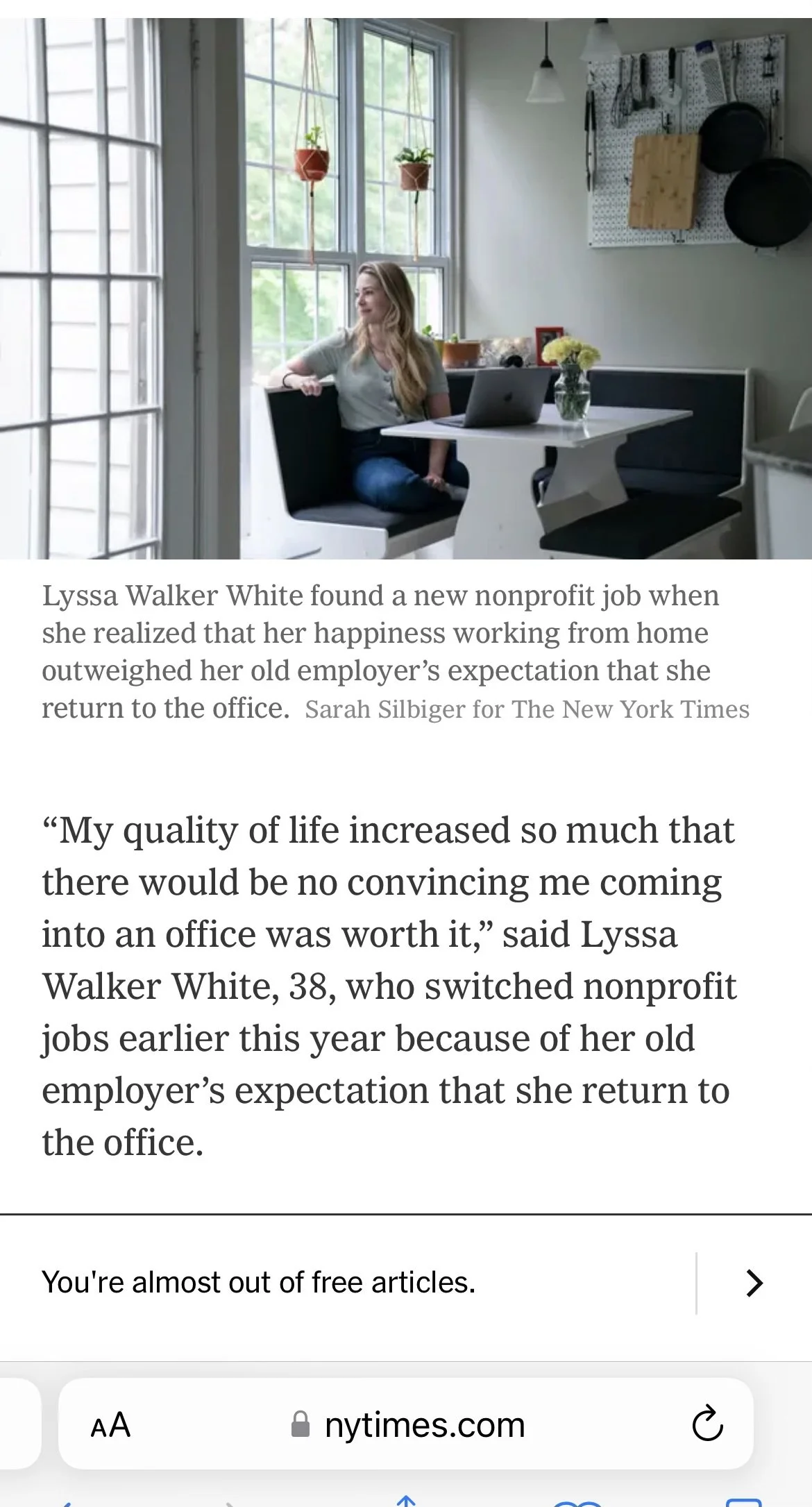
A good friend of mine, a career coach, connected me with a reporter who was looking for people to talk about remote work during the great pandemic reshuffle. At the time, I was working at an organization and had a genuinely wonderful, flexible manager. (if you ever read this: I still love you. Mean it.)
This was 2021/2022, when the world was doing that awkward half-step back into “normal.” Offices were reopening. Events were creeping back. And technically, yes, I was vaccinated. My husband was vaccinated. Science was science-ing.
But I also had a toddler who was not eligble to be vaccinated, which meant my personal risk tolerance was somewhere between “absolutely not” and “are you kidding me?” She was in a tiny home daycare, which meant if anything entered that ecosystem, it was basically a group project. And I did not want to be the one who brought Covid to the potluck of germs.
At one point, we had a potential COVID exposure. We had a lunch with a family member who we later found out have been exposed to someone who tested positive. And I started feeling pressure, not from my manager, to be very clear, but from somewhere higher up, to come into the office anyway. So I did what any reasonable person does when navigating a global health crisis: I talked to HR.
Now, I say this with love, but this HR man spoke to me like he had just been personally deputized by the CDC. He asked how we were exposed, when we were exposed, and what direction the wind was blowing. And at the end of it all, he basically said, “I think you don’t need to worry about having COVID.”
Sir.
It felt like the world had collectively decided, “We’re done here,” while a whole group of people, namely parents of young, unvaccinated kids, were still very much not done. It was like the credits rolled, but we were still in the middle of the movie.
What struck me most was how quickly we forgot the lesson. We had just proven that many jobs could be done efficiently, effectively, and sometimes even better remotely. And instead of evolving, we snapped right back to “butts in seats,” even if those butts were just sitting on Zoom… together… separately.
I love choice. Choice is freedom. If you thrive in an office, go forth. If you thrive at home, stay there. But forcing people into performative proximity? That’s not culture. That’s theater.
At some point, it became clear: my values and the organization’s direction were no longer aligned. So I started looking elsewhere, and ultimately found a fully remote role (with occasional New York travel), which I started in March 2022.
Somewhere in all of this, I spoke to that reporter. A photographer came to my house. Photos were taken. The article came out. I was featured, lightly, thankfully. A cameo, really. The “blink and you’ll miss her” of pandemic-era workforce commentary.
And then, unexpectedly, I got inquiries from national outlets—MSNBC, NPR, and others—asking if I’d come on to talk about remote work on one of their segments.
My immediate reaction was not, “Wow, I’ve made it.”
It was, “Why would you ask me?”
Not in a self-deprecating way, but in a what are we doing here as a society kind of way.
I studied journalism. I respect journalism. And one of the things that frustrates me most is how often we platform random people (hi, it’s me) as if they are subject matter experts on complex issues.
I have opinions about remote work. Strong ones. Lived ones. But do I have a PhD in organizational psychology? Am I conducting longitudinal studies on workplace productivity? No. I am a woman with a laptop, a toddler, and a very firm stance on not getting sick for no reason.
And yet, there it was. The invitation to come on television and speak with authority.
So I declined. Every single one.
Partly because I didn’t want to become the accidental spokesperson for anything.
Partly because I did not want to wake up as a “hide your kids, hide your wife” meme.
But mostly because I couldn’t shake the feeling that there were actual experts, actual stories, actual urgent issues that deserved that airtime more.
I quietly returned to my regularly scheduled programming: doing my job, raising a kid, and yelling into the void (now with slightly more credibility).
And in the most gloriously ironic twist, the article dropped while I was on a trip to my new organization’s New York office. People were flying in from all over the world and I was there masked up and quietly scanning the room for signs of extra mucus.
I strategically planted myself near open windows and gave a wide berth to anyone who so much as cleared their throat. If you looked even slightly unwell, I wished you healing… from a distance.
And then, of course, it turned into a full-blown Covid super-spreader event from which I was spared.
Which felt less like irony and more like confirmation.
Let this be a lesson: when the world hands you a microphone, the most radical move in this attention economy might very well be knowing when to put it down.